Walls are the most overlooked surface in a school playground. Planning tends to start with the floor, working out where equipment can sit and how much room children need around it, and the walls end up as nothing more than the boundary of the space.
For schools with a small playground, a narrow strip beside the building or a courtyard hemmed in on all sides, those walls are usually the largest untouched surface available. Using them costs nothing in floor area, which is what makes wall games such a practical answer for smaller outdoor spaces.
Almost every other addition to a playground takes up a lot of space. An adventure trail, a climbing frame or a play tower all need a footprint, and clear safety zones around it. In a small playground that often means losing the open area children rely on for running around.
Wall games sit outside that trade off. Mounted onto an existing wall or fence line, they add activity around the edges and leave the middle clear. They ease congestion in the centre and give quieter children an alternative to fast moving group play. They also suit phased projects, since a school can start with one or two panels and add more as budget allows.
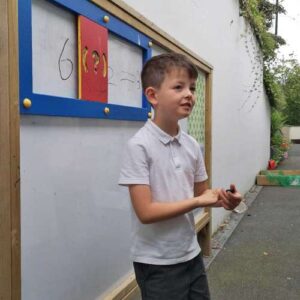
Magnetic wall games are among the most flexible options for a small space, because the play changes every time children use them. Pieces move, patterns build, and several children can use the same panel at once.
They suit EYFS and KS1 particularly well, where children are developing fine motor control alongside early problem solving. Working at a vertical surface engages the shoulder and upper arm differently to working at a table, supporting the strength children need later for handwriting.
The magnetic maths wall takes the same idea and points it at the curriculum. Number work moves outside, becomes physical, and stops feeling like a worksheet.
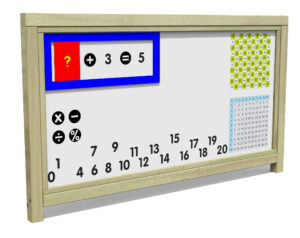
Children who find maths daunting at a desk often engage far more readily standing up and working alongside a friend. It suits number bonds, sequencing and place value, and gives teaching assistants a tool for small group work outdoors. Our posts on maths mastery and phonics, play and learning cover the wider thinking.
A wall mounted giant chalkboard is the simplest item here and often the hardest working. It needs no instructions, and children of every age find a use for it.
It becomes whatever the day needs: mark making for Reception, a scoreboard at lunchtime, a display board for a lesson. It suits children who find structured equipment intimidating. It pairs well with playground markings, giving you a vertical and a horizontal surface working together.
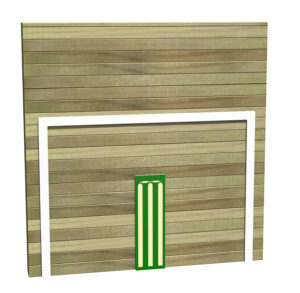
The timber target wall brings physical activity into the mix, usually the hardest thing to fit into a cramped playground. Throwing and aiming develops hand to eye coordination, and because the activity is directed at the wall rather than across open ground, it needs a fraction of the space a games area would. It opens up throwing, aiming and scoring games for children who want something active beyond football.
Every playground is different, which is why we always start with a look at the space itself.
A few things worth thinking about before you commit:
If space is your main constraint, our guides on EYFS outdoor areas on a budget and portable EYFS play equipment cover other ways to work with a limited footprint.
What surfaces can wall games be fitted to?
Most solid, structurally sound vertical surfaces, including brickwork, blockwork, render, concrete, and timber or steel fencing where the posts and rails carry the load. Condition matters more than material: crumbling mortar, hollow render or a damp wall will not hold fixings reliably. Where a wall is unsuitable, or the school does not own it, panels can go on a freestanding frame instead. We check all of this during the free site survey.
How much space is needed?
Less than most people expect. Each panel needs its own area of wall, plus enough clear ground in front for children to stand and use it comfortably, around a metre of depth. Specific measurements would be discussed at the site survey as these can range slightly. There is no safety surfacing to allow for, so the ground in front remains available for everything else.
Where panels are positioned matters more than the total area. Long, uninterrupted walls suit a run of panels spaced out along their length, which keeps children moving rather than gathering in one spot. Corners and recesses work well for the quieter activities, as they naturally feel more contained. A covered or canopy area is worth considering for anything you want used in poor weather.
Are they suitable for SEN and sensory play?
Yes, and they are often one of the first things we suggest for SEN/SEND settings. Wall mounted play is predictable. A child can approach it, use it and step away without negotiating with anyone, which matters for children who find busy playgrounds overwhelming.
There is a sensory dimension too. Magnetic panels give tactile feedback, chalk offers texture and resistance, and throwing at a target provides proprioceptive input many children seek out. Mounted at the right height, panels are accessible to wheelchair users. See our inclusive playground design ideas and our guide to sensory learning.
How long does installation take?
Wall games are one of the quickest installations we carry out. A single panel is usually a matter of hours, and a small group of panels can be completed within a day. Timings would be discussed at your free site survey. There is no excavation, groundworks or surfacing to cure, so the work can often be done in term time in a cordoned off section, or over an inset day.
A small playground does not have to mean limited play. The walls you already have can carry a surprising amount of activity without costing you a square metre of floor.
Whether you know exactly what you want or would like some ideas, our playground consultants will design something around your site and your budget. Take a look at our design ideas and guides, or book your free site survey on 01209 823181 or play@schoolscapesuk.com.


