More nurseries are moving away from brightly coloured plastic play structures towards natural play equipment. This shift is supported by growing evidence around child development, environmental awareness, and the proven benefits of nature-based learning in the early years.
Natural play equipment – mud kitchens, log balance trails, and timber structures – creates authentic learning opportunities that support the early years foundation stage framework. The sensory experiences, developmental benefits, and environmental advantages make a strong case for nurseries considering investment in their outdoor spaces.
When children interact with natural play equipment, they engage multiple sensory systems simultaneously.
Mud, wood, water, and plant materials stimulate touch, smell, sound, and sight in ways that smooth plastic surfaces cannot replicate. This multi-sensory engagement is particularly important during the early years, when children’s brains are developing at their fastest rate.
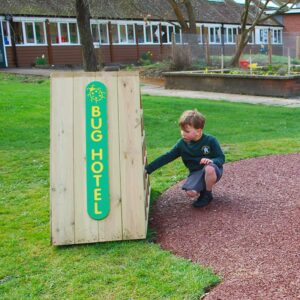
Child Kneeling infront of the bug hotel
Research into outdoor learning consistently shows that natural environments support better cognitive development, improved emotional regulation, and enhanced creativity. Natural materials encourage problem-solving, risk assessment, and imaginative play – all critical skills within the EYFS framework.
Children in natural play settings demonstrate:
A mud kitchen nursery installation is a sophisticated learning tool that addresses multiple developmental areas simultaneously. It transforms messy play – something young children are naturally drawn to – into structured, intentional learning.
When children use a mud kitchen, they are:
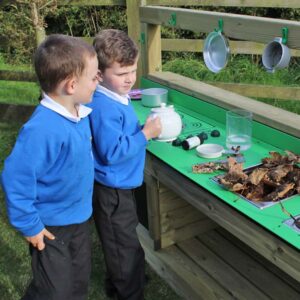
The market offers options for different spaces and budgets. An EYFS mud kitchen provides a comprehensive setup with multiple work surfaces and storage for natural materials. For nurseries with limited outdoor space, a mini mud kitchen delivers the same developmental benefits in a more compact footprint.
When choosing, consider available outdoor space, the number of children using it at once, weather protection and drainage, storage for natural materials, and accessibility for children of varying abilities.
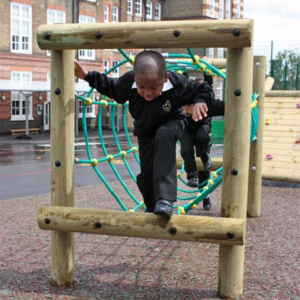
Child climbing through the rope tunnel
Log trails are among the most effective natural play equipment a nursery can install. These timber structures create progressive balance challenges that develop fundamental movement skills.
A log trail encourages children to:
Unlike static equipment, wooden log structures offer dynamic learning opportunities. Children can approach the same obstacle differently each time, constantly refining their physical skills.
Log trails work best when:
A comprehensive natural nursery playground extends beyond mud kitchens and log trails. A rich natural environment incorporates diverse elements for different types of play and learning.
Before investing, conduct a thorough assessment:
When evaluating costs, consider the total cost of ownership: initial installation, annual maintenance, replacement frequency, staff training requirements, and the impact on property appeal and parent satisfaction.
Most nurseries implement improvements in phases:
This approach spreads costs and allows staff and children to adapt between phases.
The forest school movement demonstrates the benefits of regular access to natural environments. Our guide on 11 ways to make a forest school explores how these principles can enhance nursery settings.
For budget-conscious approaches, 7 amazing EYFS outdoor areas on a budget demonstrates that meaningful natural play spaces are achievable at every price point.
Comprehensive imaginative play equipment ranges and integrated playground equipment solutions allow nurseries to create layered learning environments tailored to their specific setting.
Creating a natural nursery playground is an investment in children’s development and the reputation of the setting. Whether renovating an existing outdoor space or designing from scratch, natural play equipment should be central to the planning process.
The team at Schoolscapes UK specialises in creating natural play environments for early years settings, offering comprehensive nursery playground equipment solutions from individual mud kitchens and log trails to complete landscape designs. Contact Schoolscapes UK for a free consultation about your natural nursery playground project.


